Some sentences earn their place by being true the first time you hear them. Here is one. The thing most premium professionals get wrong about performance is that they keep stacking inputs onto a recovery floor that has already collapsed.
You can take the right peptides, run the right training program, eat the right macros, and watch the wrong outcomes. Your HRV doesn't move. Your resting heart rate creeps up. Your sleep quality degrades quietly. Your energy follows a curve that doesn't match what you're putting in.
The Recovery Reset is the protocol we built for that specific failure mode. It is, deliberately, the first protocol most SYSTEMM members run. Eight weeks of integrated work that resets the parasympathetic baseline before any other protocol gets stacked on top.
Who this protocol is for
Members presenting with one or more of: sustained training load, declining HRV trend, elevated resting heart rate, fragmented sleep, slow recovery between sessions, persistent low-grade fatigue. Often these symptoms cluster. Often the member's own perception is that they need to push harder. The data says otherwise.
The Recovery Reset exists because the answer to "why isn't anything working" is, more often than not, that the recovery system itself is the limiting factor. You cannot adapt to inputs the body cannot recover from. The protocol fixes that.
The defined outcome
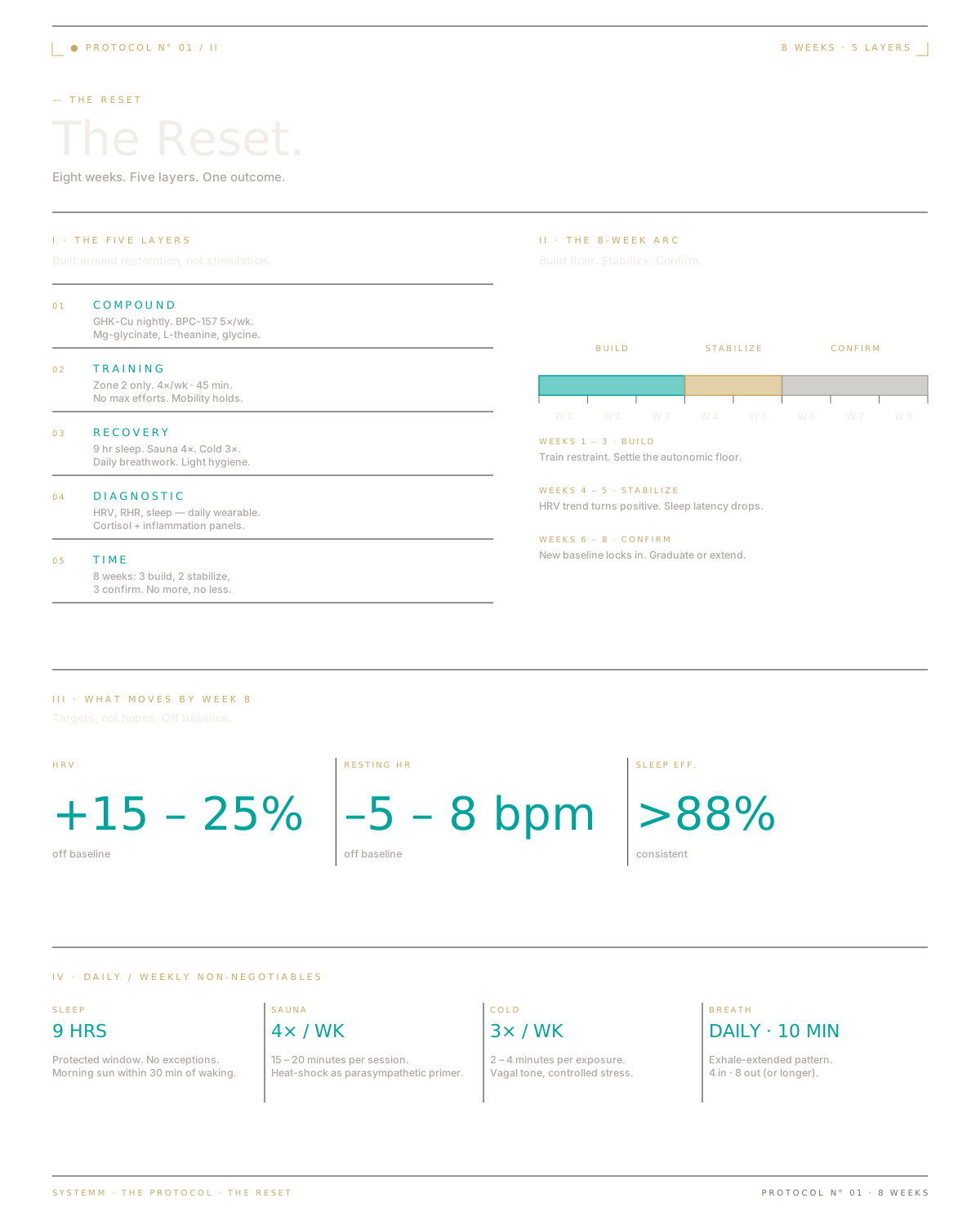
Eight weeks in, members typically see HRV up 15 to 25 percent off baseline. Resting heart rate drops 5 to 8 bpm. Sleep efficiency moves above 88 percent. Subjective energy and recovery improve in measurable ways. Most members report the difference is felt by week three or four; the trend completes by week eight.
These are typical ranges, not promises. Individual response varies with sleep history, baseline cortisol regulation, current training volume, and a dozen other inputs the clinical team accounts for during personalization.
The five layers
Compound
The compound layer is built around recovery rather than stimulation. The principal agents are GHK-Cu nightly, BPC-157 administered five times weekly, and the foundational supplement layer that supports parasympathetic function. Magnesium glycinate. L-theanine. Glycine. The compound layer is not where the heavy lifting happens. The training and recovery layers are.
Training
For the eight weeks of the protocol, training is restricted to Zone 2. Four sessions weekly, forty-five minutes each, at the aerobic intensity that the body adapts to without producing significant lactate. There are no maximum efforts. No threshold work. No interval training. Strength work is reduced to mobility holds and isometric positions.
The discipline of restricting training is, for most members, the hardest part of the protocol. This is the point. The Recovery Reset trains restraint as much as it trains the autonomic nervous system. The two are connected.
Recovery
A nine-hour sleep window is non-negotiable. Members protect it through whatever scheduling architecture works. Sauna four times weekly, fifteen to twenty minutes per session. Cold exposure three times weekly, two to four minutes. Daily breathwork, ten minutes minimum, with an exhale-extended pattern (four count in, eight count out, or longer). Light hygiene managed: morning sun within thirty minutes of waking, no blue light in the two hours before sleep.
Diagnostic
Members track HRV, resting heart rate, and sleep architecture daily through a wearable. Cortisol curves are measured at intake and at week eight. A targeted inflammation panel runs at intake and week eight. The diagnostic layer is what lets the clinical team adjust mid-protocol if the trajectory is wrong.
Time
Eight weeks. Not six. Not ten. Eight is the window the data supports for a complete parasympathetic reset in the demographic the protocol targets. The first three weeks build floor. The middle two stabilize. The final three confirm the new baseline.
The cadence
Week one is calibration. Members track their existing HRV and sleep markers to establish baseline. The compound layer is introduced at week one. Training restriction begins immediately. Members often feel worse before they feel better; the parasympathetic system is reasserting itself against months of sympathetic dominance.
Weeks three to five, the data starts to move. HRV trend turns positive. Sleep latency drops. Members report mental clarity returning at times of day when it had previously been absent.
Weeks six to eight, the new baseline confirms. The clinical team uses the week eight data to determine whether the member graduates to a follow-on protocol or extends the Reset for additional weeks.
What non-response looks like
Approximately one in fifteen members do not respond to the Recovery Reset within the standard eight-week window. The clinical team has a structured response. First, sleep apnea screening. Second, a deeper cortisol and inflammation panel to rule out underlying disorder. Third, a targeted thyroid and adrenal review.
The Reset works for most members because the limiting factor in their performance is the recovery floor. When it does not work, the limiting factor is something else, and that something else needs to be identified before any further protocol stacking happens.
Why this is the first protocol
Almost no member arrives at SYSTEMM with their recovery floor in good order. The premium professional demographic is, by definition, the one operating at the highest sustained sympathetic load. The Recovery Reset is what makes everything that follows actually work. Body composition protocols, cognitive performance protocols, metabolic protocols. None of them produce their stated outcomes if the recovery floor is collapsed underneath them.
Reset first. Stack second. That is the SYSTEMM sequence.
This is a framework. Personalized prescribing happens inside the SYSTEMM clinic in collaboration with our medical team. The Recovery Reset is published for educational purposes and does not constitute medical advice. Compounded peptides (GHK-Cu, BPC-157) are not FDA-approved and require a licensed prescriber. Do not begin, stop, or modify any component of this protocol without consulting a qualified physician familiar with your medical history.