Recovery Decision Tree.
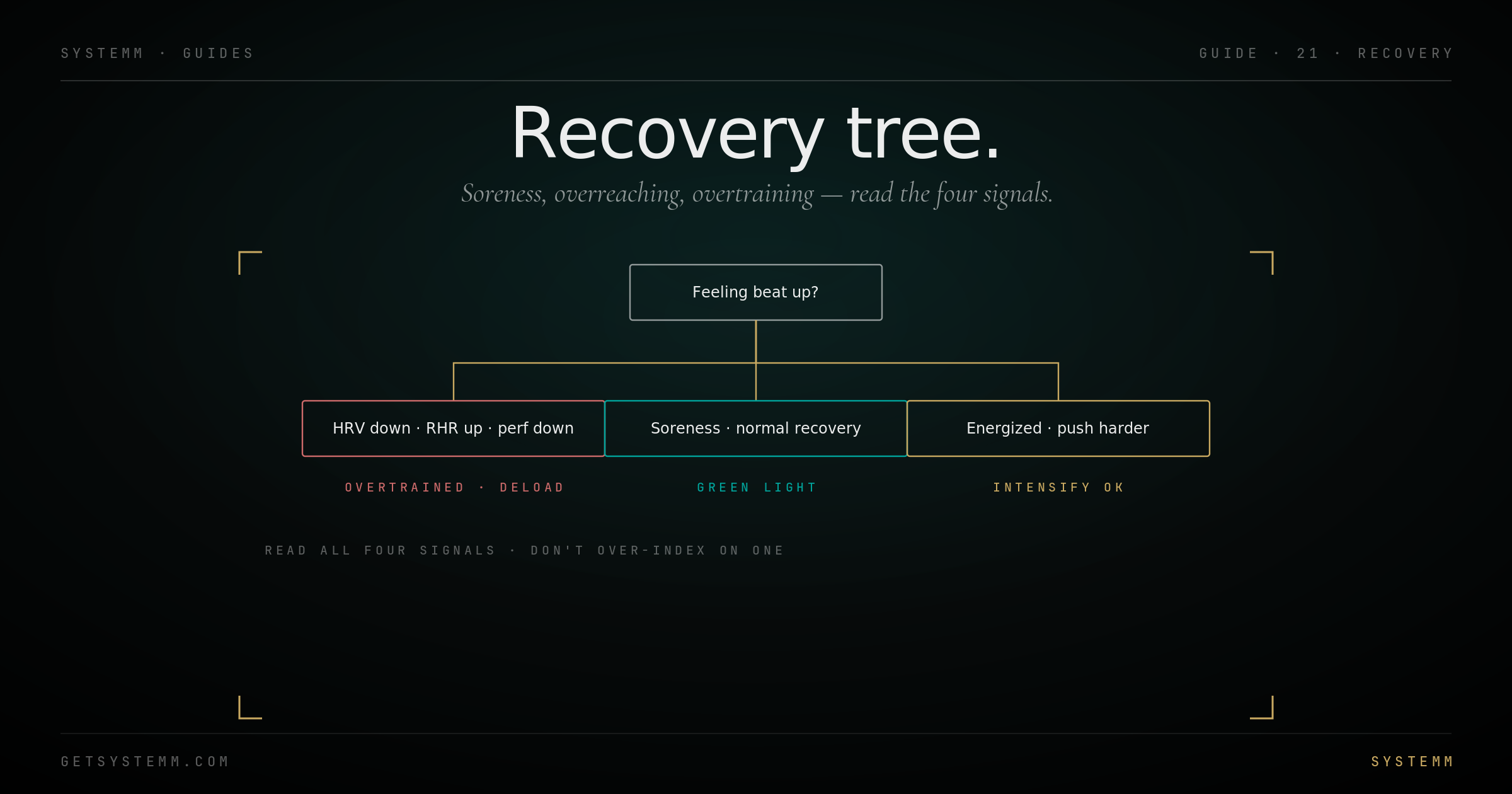
When soreness is normal, when it's overreaching, when it's overtraining. Four signals, HRV, RHR, mood, performance, read them together.
What to actually track.
Each signal alone is noisy. The combination is reliable.
1. HRV (heart rate variability). Reflects autonomic balance, high parasympathetic tone (rested) vs sympathetic dominance (stressed). Watch the 7-day rolling average, not a single morning. A 10%+ drop from your personal baseline that persists 3+ days is meaningful.
2. RHR (resting heart rate). Easier to interpret than HRV. A 5+ bpm rise above your baseline for 2+ consecutive mornings is a stress signal.
3. Mood / motivation. Subjective but real. Most overtrained athletes notice training motivation drops 1-2 weeks before performance crashes.
4. Performance. The objective ground truth. If you're losing bar speed at the same load, missing reps you used to hit, or your easy runs feel hard, the body is telling you something.
What the combinations mean.
Match your signal pattern to a state. The state tells you what to do.
What an actual deload looks like.
Most people 'deload' by reducing volume 10%. That's not a deload.
Volume deload: cut total sets per session by 40-50%. Keep intensity (weight on the bar) the same. The body needs the relative recovery; the bar weight maintains neural adaptations.
Intensity deload: alternative. Keep set count, drop weight to ~75% of working weight. Useful when you're chasing technique improvements without overload stress.
Combined deload: reduce both. Reserved for serious overreaching or competition prep tapering.
Duration: 5-7 days is enough for most planned deloads. 10-14 days for recovery from significant overreaching. Anything longer starts costing fitness rather than restoring it.
The recovery base.
Training is one input. Sleep and life stress are the other two. Track all three.
Sleep is the largest recovery lever. One night of 4-hour sleep cuts HRV the next day. A week of 5-hour nights does what a 6-hour deficit-week of training does. Address sleep before training volume.
Life stress aggregates. The body doesn't distinguish 'work stress' from 'training stress', both raise cortisol, both drop HRV. A high-stress work week + normal training load can produce the same recovery deficit as a normal week + heavy training.
Nutrition supports but doesn't fix. Adequate calories, protein at 1g/lb lean mass, micronutrients adequate. Going further (carbs around training, creatine, magnesium) has small additive effects but doesn't compensate for sleep or stress deficits.
Related.
For educational purposes only. Persistent fatigue or performance decline despite recovery interventions warrants medical evaluation. Overtraining syndrome can mimic and unmask other conditions. This information does not substitute for personalized medical advice.