Traveling.
Time zones, cold chains, customs. A protocol that crosses borders. The default kit, the dose-timing math, and what not to carry on.
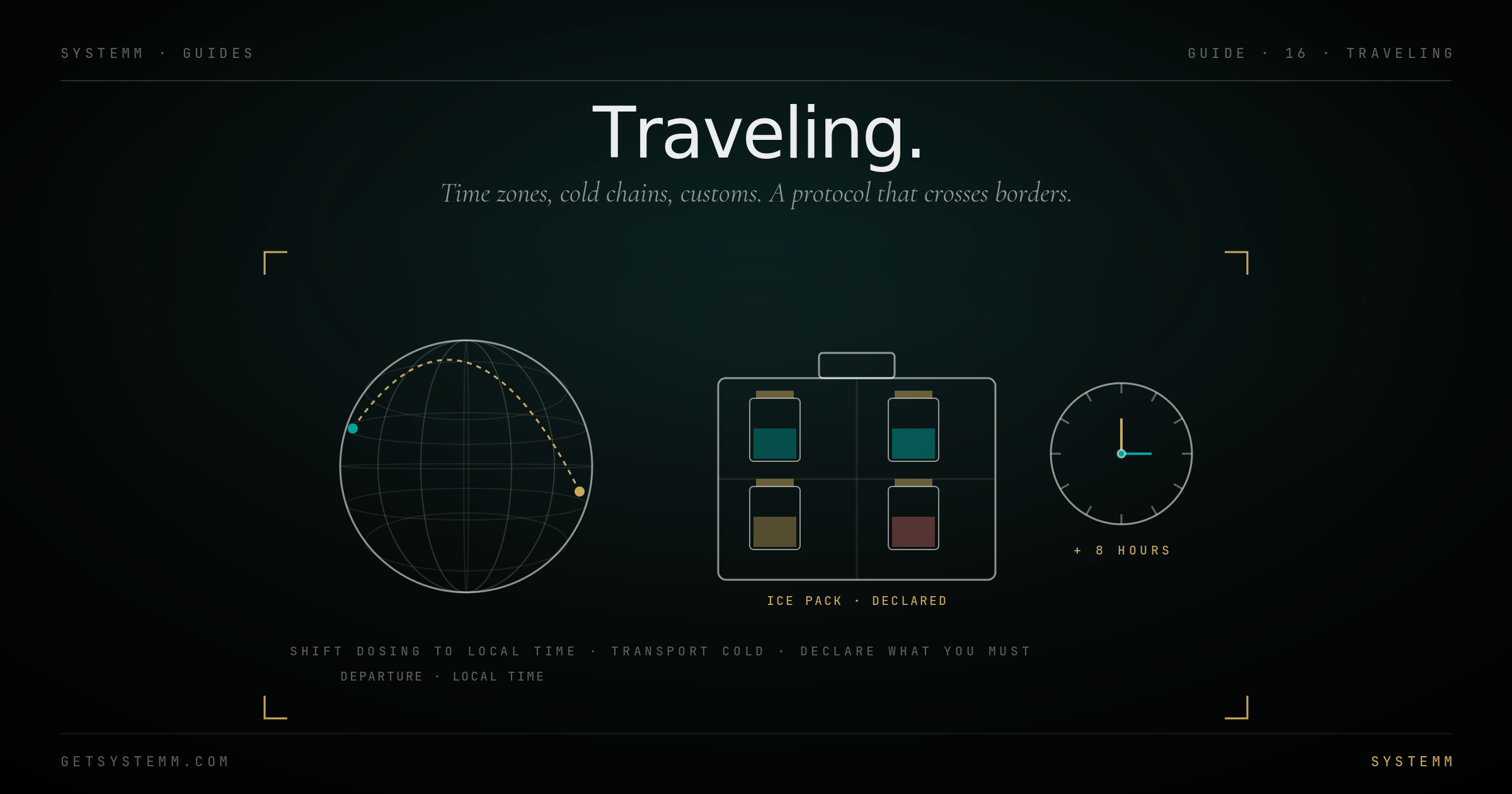
Three questions before the bag is opened.
How long, how far, how legal. Answer these and the rest sorts itself.
How many time zones? 0–3: minimal adjustment, dose on local time from arrival. 4–6: shift one dose by 2–4 hours before departure. 7+: gradual pre-shift over 2–4 days before travel; budget 2–3 days post-arrival to fully adjust.
How long away? 1–3 days: skip non-essential protocols if the bag is tight. 4–14 days: full kit, packed for the duration. 15+ days: full kit + buffer + arrange resupply at destination if relevant.
What's legal at the destination? Critical and frequently overlooked. TRT, GLP-1s, and most peptides have different legal status in different countries. Singapore, Japan, UAE, Saudi Arabia have particularly strict rules, controlled substances confiscated at customs even with US prescriptions. Check destination customs guidance for medications before flying.
- Singapore, Japan, UAE, Saudi Arabia, South Korea: Strict controlled-substance lists. Carry prescription documentation, declare proactively, expect inspection.
- Australia, New Zealand: Strict biosecurity. Peptides may require import permits.
- European Union: Generally accepting of personal-use prescriptions, but documentation expected.
- Most US domestic travel: Carry-on prescription medications fine. TSA notification not required but courteous.
What to pack and how.
One small insulated case. Original packaging where it matters. Documents in a separate folder.
Insulated travel case with reusable cold packs. Frio packs (evaporative cooling, no freezing required) work for up to 45 hours and pass airport security. Hard-shell case prevents vial breakage.
Original pharmacy packaging: keep label, prescription number, and patient name visible. Loose vials in a generic case raise questions, pharmacy-labeled vials don't.
Syringes: pack in original sealed packaging. Carry-on is allowed in most jurisdictions when accompanied by labeled medication. Sharps disposal: small portable sharps container, dispose at hotel front desk or pharmacy at destination.
Documentation folder: prescription copies, doctor's letter (if traveling internationally with peptides or TRT), original pharmacy labels photographed, customs declaration form if applicable. PDF copies on phone backed up to cloud.
Shift dosing to local time.
The body adjusts in 1–2 days regardless. Sync injections to the new clock from arrival.
Weekly injections (TRT cypionate, semaglutide, tirzepatide): inject at the same local clock time at the destination, ignoring the time zone shift. If you normally inject Sunday morning at 8am Pacific, do Sunday morning at 8am local. Don't add or subtract days.
Daily injections (most peptides): shift onto local clock from day of arrival. If you normally dose AM and PM, do AM and PM in the new time zone, even if 'AM' was technically the middle of the night in your home zone. Body will adjust within 1–2 days.
Multi-day flights with significant time zone gaps: skip one dose during transit if it falls during a flight. Don't try to dose mid-flight, security concerns plus impractical conditions.
Returning home: same logic in reverse. Resume your normal home clock from day of return. Don't double-dose or skip to 'catch up.'
When something goes wrong.
Lost luggage, spoiled vials, broken case. Plan for all three before you leave.
Lost luggage: carry critical medications and 2–3 days of supply in carry-on. Don't put TRT, GLP-1s, or active peptide protocols in checked luggage. If carry-on is also lost: contact home pharmacy for emergency local-pharmacy transfer; for international, may require local physician script.
Vial warmed past safe temperature (left in hot car, ice pack failed): discard. Don't inject compromised peptides. Cost of throwing one vial is much less than treating a contamination.
Vial broken in transit: discard glass safely; have backup if protocol is mission-critical.
Customs detention: stay calm, present documentation, accept inspection. Most issues resolve with paperwork. Document everything; if confiscated, get an incident reference for insurance / replacement.
Missed dose: weekly injections, dose as soon as remembered if within 48 hours; otherwise skip. Daily, skip and resume next scheduled dose. Don't double up.
Related.
For educational purposes only. International travel with prescription medications and peptides carries legal risk that varies by jurisdiction. Some compounds are illegal at certain destinations regardless of US legal status. Consult your prescriber and the destination embassy or customs authority before international travel with controlled or borderline substances. This information does not substitute for legal or medical advice.