Storage.
Lyophilized vial, bacteriostatic water, oil, cream. What stays stable, where, for how long. The conditions that decide whether your protocol works or quietly fails.
What's in your vial.
Four storage classes, four sets of rules. Identify the class first; everything else follows.
Lyophilized peptides ship as freeze-dried powder, visible as a small cake, ring, or scattered crystals on the bottom of a vacuum-sealed vial. Most research peptides (BPC-157, Ipamorelin, Sermorelin, TB-500, the GLP-1s, etc.) arrive this way. Stable for years pre-reconstitution; days to weeks once mixed.
Pre-mixed peptide solutions ship as liquid in a vial. Less common, generally less stable, refrigerated from the manufacturer. Examples include some sourced HCG, certain compounded peptide formulations.
Oil-based injections (testosterone esters, cypionate, enanthate, propionate, sustanon) ship in oil suspension. Room-temperature stable for years if sealed and dark.
Topical / cream / nasal preparations have their own rules per the compounding pharmacy. Generally refrigerated, often shorter shelf life than injectables.
The diluent decides shelf life.
Bacteriostatic water, 0.9% benzyl alcohol, is what makes multi-dose vials possible. Sterile water doesn't preserve and isn't a substitute.
Bacteriostatic water contains 0.9% benzyl alcohol as a preservative. Benzyl alcohol inhibits microbial growth in the vial, which is what lets you draw from the same vial across multiple days or weeks. This is the right diluent for nearly every peptide reconstitution.
Sterile water for injection contains no preservative. It's single-use only, once punctured, microbial growth starts within hours. Use for one-time large-volume reconstitutions (rare in self-injection contexts) or in clinical settings where sterility is controlled.
Sodium chloride 0.9% (saline) can be used for certain peptides per manufacturer instructions but is also typically single-use unless bacteriostatic.
Once you puncture a bac water vial, the 28-day clock starts, most pharmaceutical references cap multi-dose vial use at 28 days from first puncture. Many practitioners stretch to 30-60 days; the benzyl alcohol doesn't lose potency that fast, but contamination risk compounds over time.
The cold-chain decision tree.
Most failure modes trace to temperature mistakes. Three zones, four classes, eight rules.
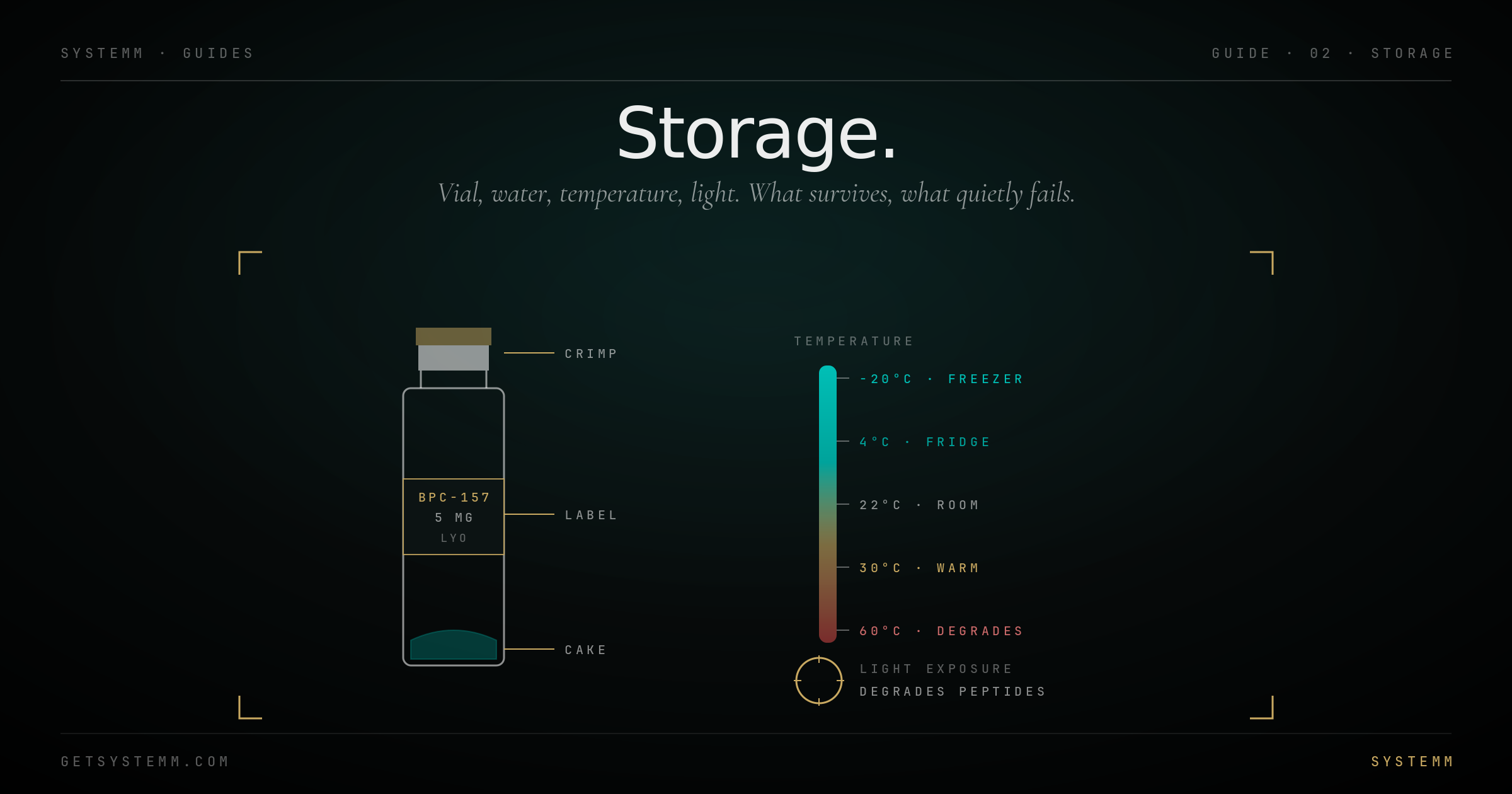
Room temperature (68 – 77 °F / 20 – 25 °C) is fine for: lyophilized peptides before reconstitution (short term, weeks to months); oil-based testosterone esters (years if sealed and dark); bacteriostatic water (sealed). Never RT for reconstituted peptides past a day.
Refrigerator (36 – 46 °F / 2 – 8 °C) is the default for: reconstituted peptides (typical 30 days); HCG post-reconstitution (typical 60 days); insulin after first use (28 days); pre-mixed peptide solutions.
Freezer (–4 °F / –20 °C) is for: long-term lyophilized peptide storage (1 – 3 years); HGH lyophilized form; bulk peptide stock before opening. Never freeze reconstituted peptide solutions, ice crystal formation breaks protein structure.
- Never repeatedly freeze and thaw, each cycle denatures more protein.
- Don't store anywhere with temperature swings, fridge door is the worst spot, the back middle shelf is best.
- Power outage longer than 48 hours: discard refrigerated peptides if they warmed past 50 °F.
- Heat exposure (hot car, direct radiator, sunny window) for hours: discard.
UV is the slow killer.
Light degradation is invisible until potency drops. Amber vials, original boxes, drawers.
UV light cleaves peptide bonds. Most pharmacy compounded peptides ship in amber glass for this reason, the brown glass blocks 90%+ of UV. If yours shipped in clear glass, store inside the original cardboard box, in a drawer, or wrapped in aluminum foil.
Direct sunlight degrades peptides in days. Even a sunny windowsill counts.
Indoor diffuse light (overhead room lights, cabinet light) degrades over weeks. Suboptimal but tolerable for short periods.
Refrigerator interior is dark when closed, but every door opening exposes the contents to kitchen light. Use a back shelf, ideally inside a small opaque container.
How long things actually last.
Rough numbers from manufacturer data and pharmacy compounding practice. Conservative, many compounds tolerate longer.
Getting your protocol on the plane.
Short trips, long trips, international, with the right packaging this is mostly a paperwork problem.
Short trips, 24 hours or less: a small soft-sided insulated cooler with one frozen gel pack keeps refrigerated peptides cold enough. Avoid direct contact between the ice pack and the vial, wrap the vial in cloth first to prevent localized freezing.
Trips 24 – 72 hours: dedicated medication travel cases (Frio, MEDpack) with embedded cooling gel work without refrigeration access. Don't trust a hotel fridge until you've tested it; some are decorative warming devices.
Air travel, domestic: medications are exempt from TSA's 3.4 oz liquid rule when accompanied by labeling or prescription documentation. Declare at the start of screening. Carry in cabin baggage, never check; cargo holds can drop to –40 °F.
Air travel, international: declare on customs forms. Bring the original pharmacy label or doctor's letter. Research-use compounds without a prescription label cross border at your own risk; many countries (Japan, UAE, Singapore, Australia) have restrictive lists. Sustanon, HCG, and GLP-1s are commonly flagged in customs even for personal use.
Sustained travel (weeks): ship a fresh supply to the destination ahead of time via a service that maintains cold chain, OR find a local source after arrival. Don't try to extend a single supply for a month-plus trip.
When to discard, not optimize.
The cost of injecting denatured or contaminated product is much higher than the cost of a replacement vial.
- Cloudiness or visible particles in a previously clear peptide solution.
- Color shift, most clear peptides should stay clear; yellowing or browning suggests degradation or contamination.
- Crystallization in an oil-based testosterone vial that doesn't redissolve after gentle warming to body temperature.
- Cracked or damaged rubber stopper, even hairline cracks, contamination risk is high.
- Past expiration date on the original label.
- Vial was warm (left in a hot car, near a radiator) for hours.
- Vial froze inadvertently (left near the freezer wall, ice pack contact).
- Power outage greater than 48 hours during which refrigerated stock was unmonitored.
The hard truth: a borderline-looking vial isn't worth the infection risk. Replace it. Peptides are cheap relative to the cost of dealing with an injection-site abscess or systemic contamination.
Related.
For educational purposes only. Manufacturer-specific storage instructions take precedence over general guidelines. Compound stability varies by formulation, purity, and additives. Consult a pharmacist or physician for substance-specific guidance.