Sourcing.
Vendors, COAs, third-party testing, red flags. The most overlooked step, and the one that decides whether your protocol is real chemistry or expensive saline.
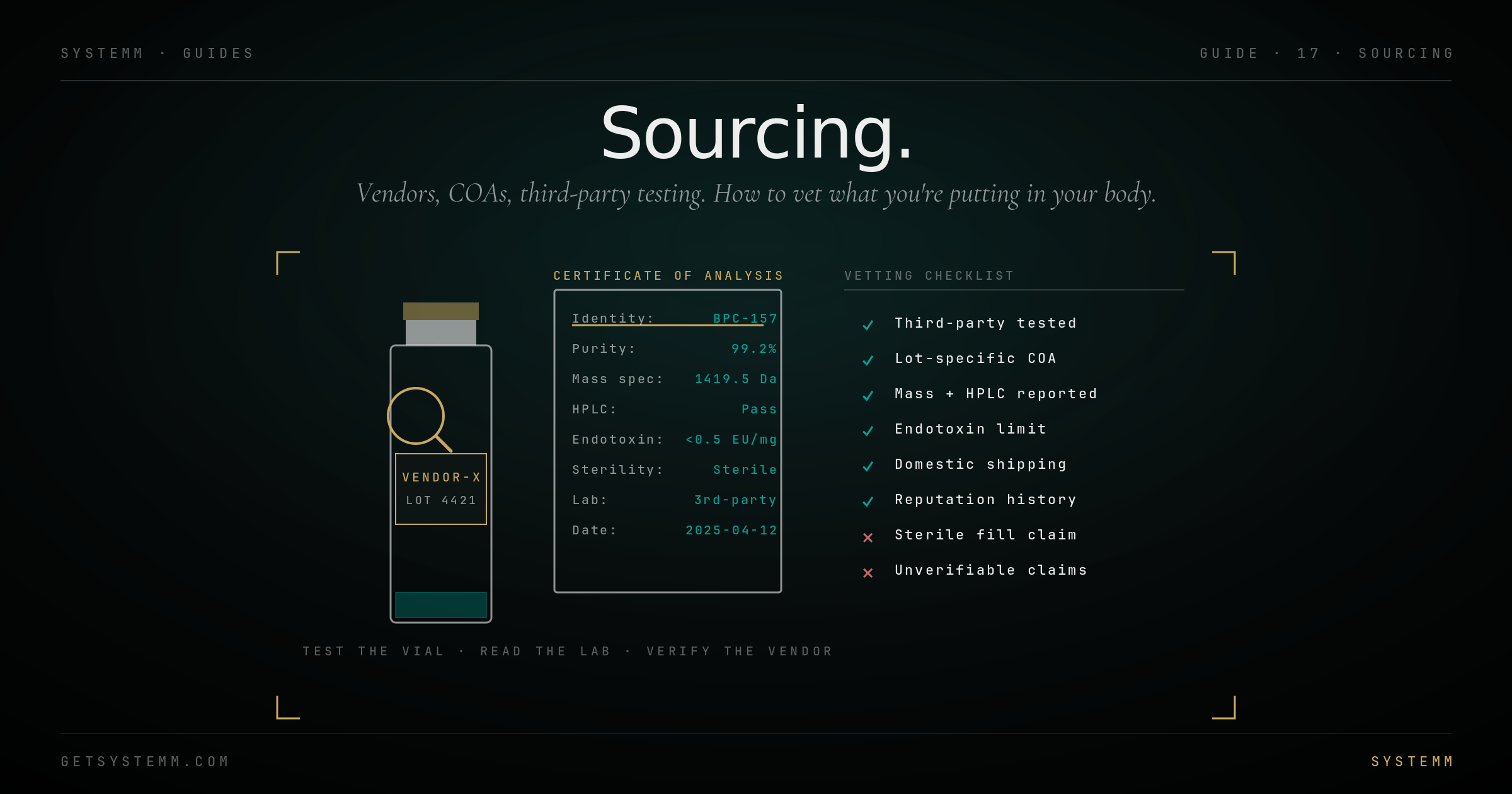
You can't dose what you can't trust.
Vendor risk is the largest single failure mode in self-administered protocols. More than dose, more than technique.
The peptide market is opaque. Most research peptides aren't sold through pharmacies, they're sold by research-chemical companies that operate in a regulatory gray zone. There's no FDA verification, no required quality control, no manufacturing standard.
What you might actually be getting: pure peptide at stated dose. Or peptide at 30% of stated dose. Or the wrong peptide. Or bacterial contamination. Or excipients that crystallize and ruin the vial. Or pure saline with a label.
The cost of getting this wrong isn't just wasted money, it's injecting unknown substances. Endotoxin contamination causes fevers, chills, systemic inflammation. Wrong-peptide contamination causes off-target effects. Underdosed protocols look like 'I'm a non-responder' and waste 12 weeks.
Vetting is mandatory, not optional. Every vendor. Every lot. Every time.
The COA is the receipt.
A real COA is lot-specific, third-party, signed, and includes the tests that actually distinguish pure from impure.
A real Certificate of Analysis is a lab report from an independent testing facility (third-party, not the vendor's in-house lab) covering a specific lot of a specific peptide. Not a generic test of 'our product' from 2 years ago. Lot match is mandatory.
Tests that matter:
- Identity, confirms it's the molecule it claims to be. Usually by mass spectrometry (matches molecular weight) and amino-acid analysis.
- Purity, by HPLC (high-performance liquid chromatography). Look for ≥98% purity. Lower is concerning unless the peptide is known to be difficult to purify.
- Mass spec confirmation, molecular weight matches reference. Detects wrong-peptide substitutions.
- Endotoxin / bacterial endotoxin testing (BET), measured in EU/mg. <0.5 EU/mg is the FDA limit for injectables. Most research peptides don't meet this. The ones that do are worth paying for.
- Sterility, required if claiming sterile fill. Many vendors don't test for this even when they claim sterility.
- Date + lab name + signature, without these, the document is unverifiable.
- Generic COA shared across multiple lots ('this lot was tested on 2023-XX-XX' for a vial you got in 2025).
- No third-party lab named, or named lab can't be found online.
- Only one or two metrics reported (e.g., just purity, no identity, no endotoxin).
- Stated purity 99%+ but no HPLC trace included.
- PDF that's clearly Photoshopped, different fonts, misaligned text, low-resolution stamps.
Eight signals that distinguish real from fake.
No single signal is decisive. The combination is.
1. Lot-specific COAs available on request. Email asking for the COA for lot #XXXXX. If you don't get one within 48 hours, walk away. Real vendors have these on file.
2. Third-party testing claimed AND verifiable. Lab name visible. Lab exists. Lab confirms the report when contacted (some users do this).
3. Domestic shipping. US-based vendors ship faster, take cards, have addresses, can be subpoenaed if they screw up. International shipping (China direct) is cheaper but adds customs risk, longer cold-chain exposure, and zero recourse.
4. Reasonable pricing. If a 5mg vial of BPC-157 is $15 and the market is $40, something's off, typically underdosed or non-peptide filler.
5. Long-running reputation. Forums (Reddit r/Peptides, r/PeptidesForSale-style threads, Trustpilot reviews). Look for vendors with multi-year track records and consistent feedback across hundreds of users.
6. Conservative claims. 'Research use only,' acknowledges legal status, no medical claims. Vendors making aggressive health claims are operating outside their lane.
7. Responsive customer service. Test with a pre-purchase question. How they answer, fast, technical, honest about limitations, is your tell.
8. Visual presentation. Pharmacy-grade labels, batch numbers, expiration dates, original packaging. Vials in baggies with hand-written labels are a hard pass.
Test what you receive.
Trust but verify. Independent testing exists for users who want to confirm.
Janoshik Analytical (janoshik.com), most-used independent testing service in the research-chem community. Send a vial; receive HPLC + mass spec results in 1–2 weeks. ~$40–60 per sample. The default if you want to verify a vendor or a specific lot.
Reddit and forum testing pools, community-funded tests of popular vendors. Search r/Peptides + vendor name + 'janoshik' to find published results.
What good results look like: purity ≥98%, mass matches reference, endotoxin reasonable. Anything below 95% purity is concerning. Below 90% is a hard fail.
What to do with bad results: dispose of remaining product, contact vendor for refund, post the results so others can avoid the vendor. The community polices itself this way.
What's legal where.
Most peptides exist in regulatory gray zones. Knowing the rules protects you.
United States: most research peptides are legal to purchase for research use, illegal to dispense for human use without prescription, and customs enforcement is inconsistent. Personal use quantities rarely prosecuted; commercial sale to humans is the line. Some peptides (BPC-157, MOTS-c, others) are on the FDA's 503A 'difficult to compound' list, restricted from compounding pharmacies but research-chem availability continues.
European Union: similar gray zone. Personal import rules vary by country.
Strict-enforcement countries (Singapore, UAE, Saudi Arabia, Japan, parts of Australia): customs seizes, possession charges possible. Don't travel internationally with research peptides through these zones.
Prescription path: telehealth clinics (Defy Medical, Maximus Tribe, Marek Health, others) prescribe pharmacy-compounded versions of some peptides legally. More expensive but lab-verified and legal. Worth considering if the legal exposure matters to you.
- Sell or distribute to others, this is the line that elevates from civil to criminal.
- Ship internationally without checking destination law.
- Make medical claims publicly, invites FDA attention.
- Buy from vendors who openly market for human use, they're flagged by enforcement.
Related.
For educational purposes only. Research chemicals are sold for laboratory research, not human use. Legal status varies by jurisdiction and changes; verify current law before purchase. This information does not constitute legal or medical advice.