Peptide Stack Building.
Three primitives, primary, synergist, optional, and the rules that keep them from working against each other.
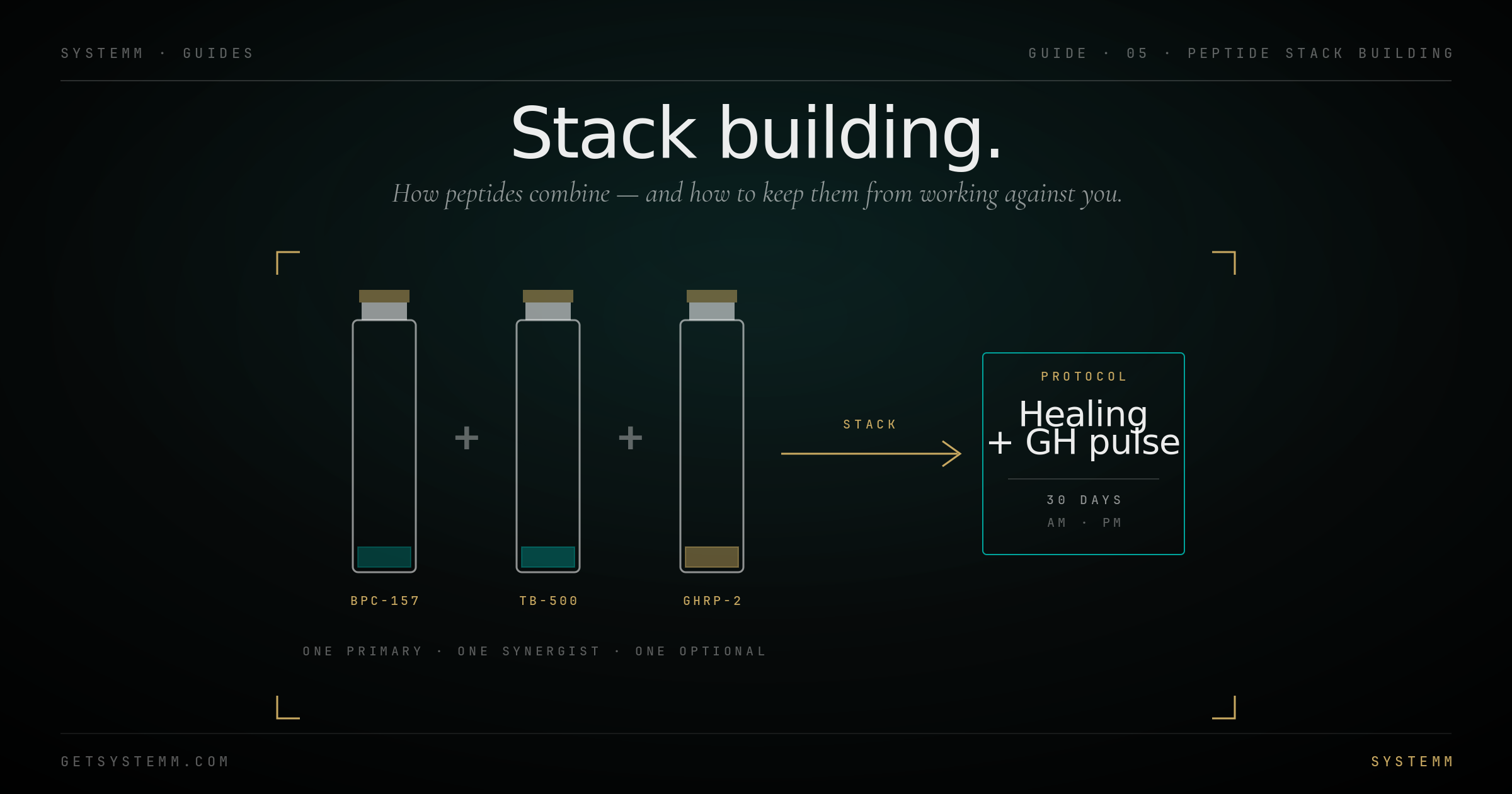
Stacks beat single agents.
Most peptides work on a single mechanism. Most goals require several. Stacking is how you cover the gap without overlapping risk.
A peptide rarely solves a goal on its own. BPC-157 accelerates tissue repair but doesn't trigger growth hormone. Ipamorelin pulses GH but doesn't repair connective tissue. A stack pairs complementary mechanisms so each contributes a different lever toward the same outcome.
Stacks are not additive, they're combinatorial. Two peptides with overlapping mechanisms double the side-effect surface without doubling the benefit. Two peptides with orthogonal mechanisms can produce results neither would alone.
Most well-designed stacks have three slots: a primary (the agent doing most of the work), a synergist (amplifies or covers the primary's blind spot), and an optional (situational addition for a specific phase or symptom).
Primary, synergist, optional.
Every stack should be readable in three lines. If you can't name each slot, you're overstacking.
Primary. The peptide closest to the goal. For tissue repair, that's BPC-157 or TB-500. For fat loss + appetite, semaglutide or tirzepatide. For GH-axis, CJC-1295 or sermorelin. The primary is the one you keep if budget or complexity force a cut.
Synergist. A peptide that amplifies the primary or covers its limitation. CJC-1295 (a GHRH analog) pairs with Ipamorelin (a GHRP) because they push GH release through different upstream signals, together they produce a larger, cleaner pulse than either alone.
Optional. A phase-specific add: PT-141 for libido during a cut, melanotan for tanning before a beach trip, GHK-Cu for skin alongside a tissue-repair protocol. The optional is where you'd cycle in and out, it's not core.
What plays well, what doesn't.
Mixing in a single syringe vs. spacing across the day. The rules are short.
Same-syringe mixing is fine for most peptide combinations after reconstitution, as long as both are stable at the same pH and not chemically reactive. CJC-1295 + Ipamorelin in the same syringe is the canonical example and standard practice.
Don't mix oil with water. Testosterone esters stay in their own oil-based syringe. Lyophilized peptides reconstituted in bac water stay in theirs. Different injection sites, often different days.
Don't mix things you don't have data on. If a published protocol doesn't show the pair in the same vial or syringe, draw separately.
- Drawing a peptide solution into a syringe that still has testosterone oil residue (oil contaminates the aqueous solution).
- Reconstituting two lyophilized peptides into the same vial before knowing both their stable diluents.
- Stacking two GLP-1s at full doses, they share mechanism and overlapping side effects without proportional benefit.
- Adding melanotan to a healing stack, its appetite suppression and nausea will dominate before the BPC-157 has a chance to work.
Time of day and meal proximity.
GH peptides hate insulin. Tissue-repair peptides are timing-flexible. The half-life sets the cadence.
GHRH / GHRP peptides (CJC, Sermorelin, Ipamorelin, GHRP-2/6, Tesamorelin) want to be injected on an empty stomach, at least 2 hours after a meal, no food for 30 minutes after. Insulin and elevated blood glucose blunt the GH pulse. Best windows: first thing AM (overnight fast), pre-bed (3+ hours after dinner), and pre-workout fasted.
BPC-157 and TB-500 are timing-flexible. Most protocols do once or twice daily. Co-administration with food has no documented downside.
GLP-1 agonists have very long half-lives (semaglutide ~165h, tirzepatide ~120h). Inject once weekly on a fixed day; meal timing irrelevant.
Short-half-life peptides (PT-141, Selank, Semax) are dosed acutely for the effect window, minutes to hours before the use case.
How long to run a stack.
Most stacks have a built-in expiry. Knowing it up front protects against drift.
Tissue repair stacks (BPC + TB-500 + optional): 4 to 8 weeks for an acute injury. 12 weeks for chronic. Stop when symptoms resolve or progress plateaus, don't run indefinitely.
GH-axis stacks (CJC + Ipa): Common protocols run 8 weeks on, 4 weeks off, repeat. Receptor sensitivity drops with continuous use; the off-cycle restores it.
GLP-1 protocols: Titrate up over 12+ weeks, hold at the effective dose 6–12 months for fat loss, then taper. Lifetime maintenance dosing is also an emerging pattern in some clinical settings.
Optional / situational peptides: Use only when needed. PT-141 the night of, melanotan in pre-summer cycles only, GHK-Cu when skin work is active.
How you'll know it's working.
Pick one objective metric per stack. If the metric doesn't move, the stack doesn't either.
Pick one primary endpoint before starting. Tissue repair: pain on a 0–10 scale, range of motion, return-to-activity date. GH-axis: IGF-1 at 6 weeks, body composition (DEXA or InBody), sleep depth. Fat loss: scale weight + waist circumference + DEXA every 12 weeks. Pick a number, write it down.
Track one secondary at the same interval, for safety or side effects. Hematocrit on TRT. Fasting glucose on GLP-1s. Resting heart rate on stims. Anything where a number going the wrong way means stop.
If the primary hasn't moved by 25–50% of the protocol length, reassess. Maybe the dose is too low, maybe the stack is wrong, maybe the goal is wrong. The default is not 'wait longer.'
Related.
For educational purposes only. Most peptides are research chemicals not approved for human therapeutic use in most jurisdictions. Combining peptides amplifies both effects and risks. Consult a qualified physician familiar with peptide protocols before initiating any combination. Document baseline labs and recheck on a schedule. This information does not constitute medical advice.