Bloodwork Basics.
What to test, when, why, and how to read it. The objective layer underneath subjective symptoms, and the cadence that catches problems before they become problems.
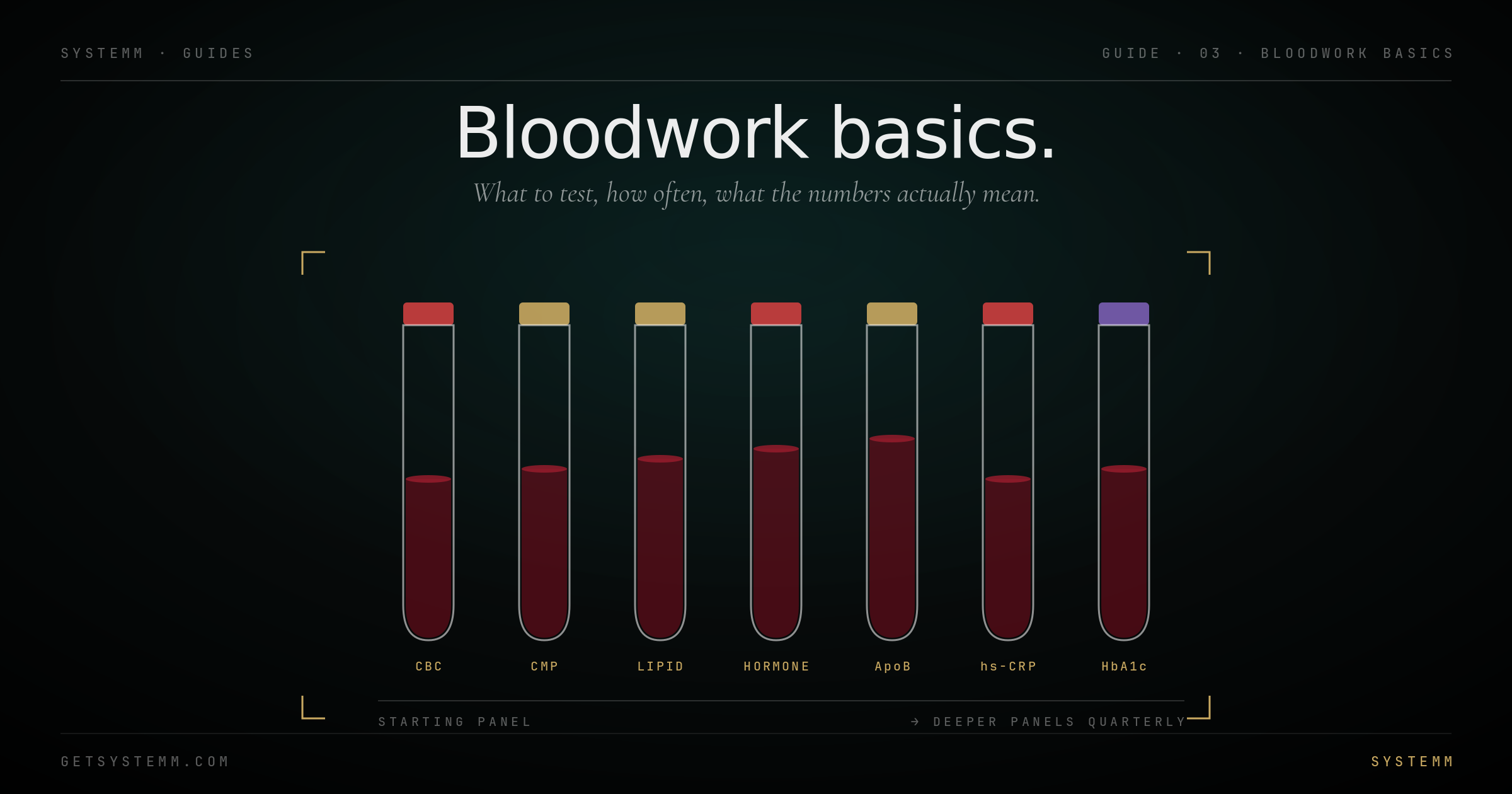
The honest baseline.
Symptoms lag biology. Bloodwork catches drift months or years before you'd feel it. Trends matter more than single readings.
Self-reported energy, mood, libido, and recovery are subject to placebo, stress, sleep, and last week's training block. Lab values are not. Bloodwork is the objective layer underneath subjective symptoms, the place where 'I feel off' becomes 'free T at 380, SHBG at 65, hsCRP at 3.8.'
Trends matter more than single readings. One elevated cortisol could be the morning you fought your kid getting out the door. Six months of climbing cortisol is a signal.
Reference ranges are not optimal ranges. Lab reference ranges describe 95% of the population, which includes most of the population in suboptimal metabolic health. 'In range' frequently isn't where you want to be.
Bloodwork is preventive infrastructure. The cost of a comprehensive panel (typically $200 – $600 cash) is trivial against the cost of catching a problem ten years late.
What every adult should ask for.
The baseline workup. Order once. Re-run yearly minimum.
Whether through a PCP or a direct-to-consumer service, this is the floor every adult should know. It maps to about a dozen vials of blood and 30 – 50 individual markers depending on the lab.
- CBC (complete blood count), hemoglobin, hematocrit, WBC, platelets. Catches anemia, polycythemia, infection signals.
- CMP (comprehensive metabolic panel), glucose, kidney function (BUN, creatinine, eGFR), liver enzymes (ALT, AST), electrolytes.
- Lipid panel, total cholesterol, LDL-C, HDL-C, triglycerides. Useful but limited; pair with ApoB.
- ApoB, the actual count of atherogenic particles. The most informative cardiovascular lipid marker. Often must be requested specifically.
- Lp(a), genetically determined; check once in lifetime. Above 50 mg/dL is high cardiovascular risk.
- hsCRP, high-sensitivity C-reactive protein. Chronic systemic inflammation marker; cardiovascular risk signal.
- HbA1c, 3-month average blood sugar.
- Fasting glucose + fasting insulin, calculate HOMA-IR to assess insulin sensitivity. Optimal HOMA-IR <1.5.
- TSH, Free T4, Free T3, Reverse T3, full thyroid panel. TSH alone misses cellular thyroid function issues.
- Sex hormones, Total T, Free T, SHBG, Estradiol (sensitive assay), DHEA-S. (See expanded panels below by sex.)
- Vitamin D (25-OH-D), target 50 – 70 ng/mL. Most adults are deficient.
- Ferritin, iron stores. Acute-phase reactant too, so interpret in context.
- B12 + Folate, methylation cofactors.
- Homocysteine, methylation status, cardiovascular risk.
What men should add.
- Total Testosterone, LC-MS/MS preferred over standard immunoassay. Optimal: 600 – 1000 ng/dL for symptom-free function.
- Free Testosterone, the bioavailable fraction. Often more clinically relevant than total. Many men have 'normal' total but low free.
- SHBG (Sex Hormone Binding Globulin), binds T and E2, making them unavailable. High SHBG with normal total T = low free T = symptoms.
- Estradiol (sensitive assay), must be LC-MS/MS. Standard immunoassays cross-react with other compounds and overestimate. Male optimal: 20 – 40 pg/mL.
- LH and FSH, distinguish primary (testicular) vs secondary (pituitary) hypogonadism. Essential before any TRT decision.
- Prolactin, elevated prolactin (>15 ng/mL) suggests pituitary tumor or other pathology. Rule out before assuming low T.
- DHT (Dihydrotestosterone), order if assessing hair loss or considering 5α-reductase inhibitors.
- PSA, annually from age 40, earlier if family history. Even non-prostate-cancer patients should have a baseline.
What women should add.
Cycle timing matters for premenopausal women. Day 3 vs day 21 reads completely different.
- Cycle timing. Premenopausal: draw on cycle day 3 for baseline FSH/LH/E2/Progesterone; day 21 (mid-luteal) for progesterone confirmation. Postmenopausal: any day.
- Total + Free Testosterone, SHBG, DHEA-S, same panel as men, different ranges. Female T optimal: 25 – 70 ng/dL total.
- Estradiol, cycle-dependent in premenopausal women. Postmenopausal optimal varies with HRT decisions.
- Progesterone, day 21 luteal phase confirmation of ovulation.
- LH and FSH, perimenopausal staging marker. FSH rises before menopause.
- AMH (Anti-Müllerian Hormone), ovarian reserve. Drops as menopause approaches. Useful for fertility planning.
- TSH + thyroid panel, women have higher rates of thyroid dysfunction, including subclinical hypothyroidism.
Insulin is the underordered marker.
HbA1c is downstream. Fasting insulin and HOMA-IR catch insulin resistance a decade earlier.
Fasting insulin is one of the most informative tests almost nobody orders. Insulin resistance shows up here years before HbA1c rises. The pancreas compensates by pumping more insulin until it can't anymore, by then, you have type 2 diabetes.
HOMA-IR = (fasting glucose mg/dL × fasting insulin µIU/mL) / 405. Optimal <1.5. Above 2.5 is insulin resistance. Above 5 is significant metabolic disease.
Fasting glucose alone is a late marker. Glucose stays in the normal range while insulin doubles, then triples, until the system breaks. Don't trust 'glucose normal' as 'metabolic health normal.'
C-peptide, measures endogenous insulin production directly. Useful when distinguishing type 1 vs type 2 diabetes or assessing pancreatic function on a GLP-1.
The number that actually predicts heart attacks.
LDL-C measures cholesterol mass. ApoB counts atherogenic particles. The latter is what plaques arteries.
LDL-C is the marker most physicians order. ApoB is what you actually want to know. Each atherogenic particle (LDL, VLDL, IDL, Lp(a)) carries exactly one ApoB. So ApoB count = atherogenic particle count.
When LDL-C and ApoB disagree, common in people with small-dense LDL, metabolic syndrome, or diabetes, ApoB is the truthful number. People with discordant readings (low LDL-C, high ApoB) have high cardiovascular risk that LDL-C masks.
Optimal ApoB: <80 mg/dL for low-risk individuals. <60 mg/dL for aggressive prevention. Above 100 mg/dL: elevated risk regardless of LDL-C.
Lp(a) is genetic, measure once. If high, it informs how aggressively to manage all other modifiable risk factors. PCSK9 inhibitors are the main therapy that lowers it.
Non-HDL cholesterol (total minus HDL) is a reasonable proxy when ApoB isn't available, but order ApoB if you can.
The silent driver of chronic disease.
Chronic low-grade inflammation tracks underneath almost every age-related disease. Three markers worth watching.
- hsCRP, high-sensitivity C-reactive protein. Optimal <1.0 mg/L. Above 3.0 is high cardiovascular risk. Don't draw within 2 weeks of an infection or vaccination, it'll be temporarily elevated.
- Ferritin, iron stores AND acute-phase reactant. Above 300 ng/mL warrants investigation: hemochromatosis or chronic inflammation are the two main causes.
- Homocysteine, methylation status indicator and independent cardiovascular risk factor. Optimal <8 µmol/L. Lowering it via methylated B-vitamins is straightforward when elevated.
- ESR (Erythrocyte Sedimentation Rate), slower, less specific than hsCRP but useful when investigating autoimmune disease.
- IL-6, TNF-alpha, research-grade cytokine panels. Rarely ordered clinically; useful in specific contexts.
When to draw.
Draw conditions matter. Fasted (8 – 12 hours), AM (7 – 9 AM ideally, testosterone and cortisol are diurnal), hydrated, not after a heavy training day. Avoid alcohol for 48 hours before. Same time of day for trend comparisons.
PCP vs direct-to-consumer.
Through your PCP, usually covered by insurance, slower turnaround, often limited to standard panels. Some PCPs will order anything you ask for; others won't. Many won't order sensitive estradiol, ApoB, fasting insulin, or full thyroid panels unless they see a reason.
Direct-to-consumer services, Marek Diagnostics, Quest Direct, Labcorp OnDemand, Discounted Labs, Empower, InsideTracker. Faster, more markers available, out-of-pocket. No insurance friction. You order what you want; they run it.
For TRT or hormone-related panels: Discounted Labs and Marek are commonly used by men on TRT for routine monitoring at lower cost than insurance copays.
For comprehensive longevity-focused panels: InsideTracker, Function Health, Marek's comprehensive package. More expensive, more markers, includes interpretation.
Reference range is not optimal range.
The yellow flag system most lab reports use reflects population norms, not health. Optimize toward upper quartiles for most markers.
Lab reference ranges describe the middle 95% of the population tested. The population tested includes the obese, the chronically stressed, the sleep-deprived, the metabolically unhealthy. 'Normal' in a lab range frequently isn't optimal.
For hormones: aim for young-adult mid-to-upper range. A 50-year-old man with testosterone at 400 ng/dL is 'in range' but symptomatic; he likely feels much better at 800.
For cardiovascular markers: aim for the bottom of the range, not the middle. ApoB <80, hsCRP <1, LDL-C <100.
For metabolic markers: fasting insulin <6 µIU/mL, HbA1c <5.4%, HOMA-IR <1.5.
For thyroid: TSH 0.5 – 2.5 (not the 0.5 – 4.5 standard range), Free T3 in the upper third, Free T4 in the middle third.
Track YOUR baseline over time. Your own trend line matters more than the population reference range. Drops or rises that stay within 'normal' but represent a 30% change from your baseline are meaningful.
Related.
For educational purposes only. Lab result interpretation is highly individual and depends on clinical context, medications, recent illness, and many other factors. Always discuss results with a qualified physician before making medical decisions.